A Formula 3000 car which is too fast to perform on most New Zealand race tracks, will be testing the limits of Wanaka's airport runway during the Warbirds Over Wanaka airshow this Easter. In what will be a first for the airshow, the machine will race against world aerobatics champion Jurgis Kairys in his specially designed Sukhoi aircraft. Kairys has been winning world aerobatic titles for over 25 years and has advanced the highly-competitive sport through aircraft design innovations and the pioneering of new aerobatic manoeuvres.
The car's driver, John Crawford of Christchurch, said the Reynard 92D F3000 could travel at speeds in excess of 320kmph and could go from 0 to 160kmph(100mph) in around 3 seconds. Mr Crawford, who operates a motorsports business in Christchurch, has demonstrated the car previously but never raced it.
"Basically there are very few tracks that it is allowed to race on. It is 480hp and weighs only 600 kilograms including the driver. "I don't know how we'll go, the biggest worry for me will be getting stopped before the end of the runway."
It was not only farmers in the Upper Clutha breathing a sigh of relief after recent heavy rain. Warbirds Over Wanaka pyrotechnic expert Kevin 'Bomber' Harris was also delighted with the downpour which will now allow explosives practice to go ahead.
The extremely hot, dry summer had been set to delay practice for Mr Harris and his team who are planning some spectacular and explosive antics for the Easter holiday airshow. Mr Harris said yesterday that while conditions remained dry and the grass had to be kept very short to lessen the risk of fires, he was now confident in utilising the special permit which allows essential practices to take place before the show during a general fire ban period.
The sessions, which would begin "any day now", were as much about staff training as anything else, he said. "We have different guys here each show so we have to make sure they are up to speed."
Mr Harris has been involved with every show since Warbirds Over Wanaka began in 1988. The now-famous pyrotechnic displays were brought in when airshow founder, Sir Tim Wallis, decided there needed to be more excitement and drama in the show.
An expert was bought in to give the Wanaka enthusiasts a few pointers and Mr Harris and his various teams set about gaining knowledge along the way from other people, and by trial and error. The biggest enemy of the pyrotechnician, he said, was grass fires. This was because of damage being done to electrical wires which allow the explosions to be detonated.
"If you get a grass fire at the start of a display its bad because it means the rest of the explosions won't happen."
The team were extremely safety conscious, and had a perfect safety record despite some of the more elaborate antics undertaken, he said. "We dropped a caravan out of a helicopter one year, we've dropped a van, we've had buzz bombs, massive fireballs, submarines and we've blown up buildings."
The crew use around four kilometres of electrical wire to set up the explosions, along with 12-volt dry cell batteries, heavy pipes, petrol, waratahs and a lot of number eight wire. How the massive fireballs were created had to remain a secret, he said, to prevent people trying to re-create the effect at home.
As for the plan for this year's show that too was being kept a secret but there was a strong possibility, Mr Harris said, that the airfield could be visited by, among other things, a cannon and a large undersea vessel.
General Manager of Warbirds Over Wanaka, Gavin Johnston, announced today that a warbird would feature in a live gun-firing exhibition for the first time ever at an airshow in New Zealand. "An Auckland based Curtiss P-40 Kittyhawk has been fitted with working guns. The guns will be fired from the aircraft as it takes part in the show", he said.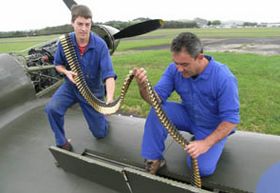
The Chairman of the Warbirds Over Wanaka Community Trust, Garth Hogan, said "The P-40 will fire all six machine guns in an historic re-enactment of attacks on shipping over Rabaul during 1944. The public have never had the opportunity to see such an exciting event. The sound from these guns firing is seriously loud".
As the aircraft passes along the display line at over 240mph (386 km/h) it will fire at the barge in 2-second bursts. In that time the aircraft will have travelled over 700ft and the guns fired more than 60 rounds.
"The sight, sound and smell of these guns firing is a unique opportunity to see what it was like when these aircraft flew in anger during the war", Garth said. "This event is exclusive to Warbirds Over Wanaka International Airshow 2008. No where else in New Zealand (or the world) will you see anything like it".
The live firing exhibition will take place on both the Saturday and Sunday of the show.
An LC-130 ski-equipped Polar Hercules will make a debut appearance at Warbirds Over Wanaka this year, Gavin Johnston, General Manager of Warbirds Over Wanaka International Airshow, announced today. The aircraft is used by the New York Air National Guard for Antarctic support and will be attending the airshow on static display.
The Lockheed LC-130 Polar Hercules was developed from the C-130 Hercules which is currently operated by the RNZAF. The Hercules first flew in 1954 and in 1959 the original wheeled version began flying to the Antarctic in support of Operation Deep Freeze. In 1961 a modified ski equipped version was introduced which allowed aircraft to fly to the South Pole in conjunction with the Antarctic operations.
The US Navy flew the Antarctic flights until 1998 when the New York Air National Guard took over the operation and they now fly the only ten active LC-130's remaining. The LC-130 Hercules is the largest ski equipped aircraft in the world. The ski modification is not a simple retrofit but rather a major modification to both the landing gear and the actual fuselage. The main skis are 5.1m long and the complete ski units add 2.5 tonnes of weight to the aeroplane.
"In past Warbirds Over Wanaka Airshows, the RNZAF has demonstrated its C-130 Hercules, but this is the first time this significantly different aircraft, an LC-130 Ski Equipped Polar Hercules has attended", Mr. Johnston said. "With a RNZAF Hercules taking part in the flying display, this will be a unique opportunity for the public to see two different variants of the same aircraft type".
"The aircraft is one of six New York Air National Guard with a New Zealand connection. The aircraft are equipped with Nelson based company FlightCell's DZM tracking hardware, which allow the aircraft to be tracked anywhere in the world by Dunedin based global tracking company Daestra New Zealand, enhancing safety and improving operational efficiencies in one of the worlds most extreme climates."
An exciting segment at the Warbirds Over Wanaka Airshow this year will be the display of a number of types of aircraft from the Vietnam War era in an operation typical of those conducted during the conflict. The re-enactment is not intended to be operationally authentic, but is intended to tell a story of how these aircraft were used, and display them to the public.
Warbirds Over Wanaka General Manager, Gavin Johnston said, "Warbird pilots will fly an O1 Bird dog as did Forward Air Controllers, (target markers) and Hughes OH-6 (500) helicopters in re-enactment missions as they did in the conflict. Attacks will be made by a Trojan T-28, doing strafing and bombing runs, and UH-1H Iroquois helicopters of the Royal New Zealand Air Force, firing blank ammunition".
To conclude the scenario, the Royal Australian Air Force will display the DHC-4 Caribou, an aircraft which featured prominently in re-supply missions in the Vietnam conflict. The group "Warhorses at Wanaka", will provide both friendly and enemy ground troops for the scenario.
Although the RNZAF did not deploy any units to this war, 16 of their helicopter pilots were attached to No. 9 Sqn RAAF, flying troops in and out of the front line. Fourteen strike pilots served with 7th USAF as Forward Air Controllers, (target markers), flying the O1 Birddog, Cessna 337 O-2A and OV-10 NAA Bronco. One ex- RNZAF pilot flew bombers with the RAAF in this theatre. Several NZ Army pilots flew Bell 47 observation helicopters with the Australian Army.
The Royal Australian Air Force (RAAF) has confirmed a big show of force at the Warbirds Over Wanaka International Airshow 2008. General Manager Gavin Johnston said, "This will be the largest and most impressive involvement yet by the RAAF".
The RAAF has confirmed the return of the F-111 supersonic long range strike aircraft, which was so spectacular, and such a hit with the large crowd at the 2006 airshow. Its signature "Dump and Burn", using fuel dump and afterburner, will again thrill the large crowds expected for this year's show.
Australia's newest acquisition to the fleet, the C-17 Globemaster, will debut at WOW 08. The C17 is a high wing four jet-engine heavy transport. It has three times the carrying capacity of the C-130 Hercules transport aircraft used by the Royal New Zealand Air Force and the RAAF, and will provide something very different from anything seen at previous shows.
A favourite with airshow crowds is the venerable DHC-4 Caribou twin piston-engine light transport. Introduced in 1964 and employed in Vietnam, this short take off and landing aircraft rounds off the three RAAF types appearing at the show. Three DHC-4 Caribous will be appearing the event.
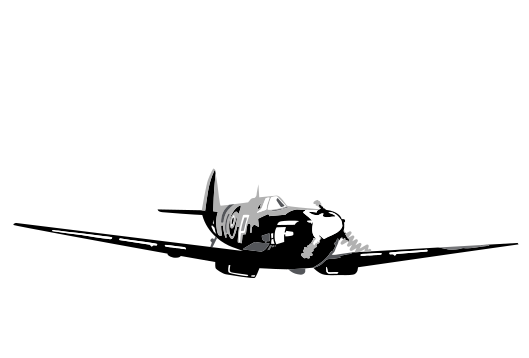
A Supermarine Spitfire will make its South Island airshow debut at the Warbirds Over Wanaka Airshow 2008. Making the announcement today, General Manager Gavin Johnston said "We are so pleased that an iconic Spitfire will again be seen at Wanaka".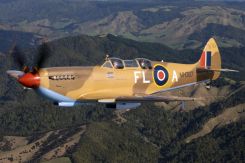
Her new owner, Doug Brooker of Auckland, has imported the aeroplane from the USA after a lengthy rebuild. It made its maiden flight from Bartow, Florida on the 16th September 2007.
This particular Spitfire is a Mk IX and is fitted with two seats. It is the first time a Spitfire like this will have been seen flying in the Southern Hemisphere. After WWII, Supermarine developed a two seat trainer version of the Spitfire and the type was used by the Israeli and Irish Air Forces. The aircraft is painted to represent the Spitfire flown by American Major Robert Levine of the 4th Fighter Squadron in the Middle East.
Warbirds over Wanaka is excited to announce the New Zealand debut of the world renowned "Air Bandits" aerobatic team at Wanaka next Easter.
Aerobatic champions Jurgis Kairys, Rob Fry and Yoshiro Moroya combine as the world famous "AIR BANDITS" aerobatics display team. Rather than a strict formation team using the same type of aircraft, the Air Bandits are a flying entertainment package. Sometimes playing together, sometimes seemingly doing their own thing, but always in a dynamically choreographed display of precision flying.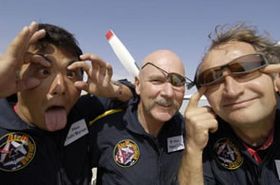
The "flying entertainment package" concept was designed by Jurgis Kairys to perform a new and refreshingly different style of airshow display. Diverse aircraft types, flown by diverse nationalities on a diversity of flight paths produce lots of noise, lots of smoke and what Jurgis himself calls, 'well organized chaos'.
Jurgis was born in Siberia and brought up in Lithuania. He graduated as an aircraft engineer, in airframes, and commenced flying training. Excelling in aerobatics, Jurgis became a member of the elite National Team at the Kaunas Flying Club in Lithuania. His engineering and undeniable piloting skills were recognized when he was asked to work with the Sukhoi Design Bureau to develop the Sukhoi 26-29-31 series of completely new aerobatic aircraft. The many times World Champion has invented several specially designed aerobatic manoeuvres which displays his considerable talent and that of his team members, New Zealander Rob Fry and Japanese Yoshihide Muroya.
Rob Fry was born in Auckland, a one time professional yachtsman, he has been resident in Japan for 23 years as a businessman and keen aerobatic pilot. He teamed up with Jurgis in 1999 and has been helping with his organization and flying displays on and off ever since.
Yoshiro Moroya is known as the leading aerobatic pilot in Japan, having flown over 120 airshows, many of them with Jurgis. The aircraft being used at Warbirds over Wanaka will be the Juka, the Sukhoi 26 and the Yak 50, all different airframes with the only resemblance being the 9 cylinder M14P radial engine.
The new Trust has been formalised and its charitable status approved. Trustees are Mr Murray Cleverley (Timaru), Mr Bill Gordan (Wanaka), Mr Stephen Grant (Dunedin), Mr Garth Hogan (Wanaka/Auckland), and Mr Ray Mulqueen (Wanaka).
Mr Gavin Johnston continues in the full time General Manager role and has 2008 planning well underway with ticket sales via the Internet having commenced this month. Mr Graeme Ramshaw will retain a part time Executive Officer role with the new organisation.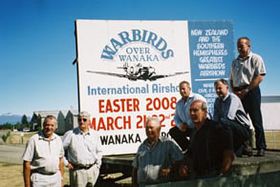
The skill set that the Trustees of the new Trust bring to Warbirds Over Wanaka combined with the knowledge and background of existing management will ensure that the legacy created by Sir Tim Wallis and Alpine Deer Group can continue on into the future and continue to bring substantial benefits to Wanaka, the Upper Clutha, Queenstown Lakes and surrounding districts.
The new interim chair Mr Garth Hogan said "the community and New Zealand are indebted to Sir Tim, the Wallis family and Alpine Deer Group for providing a legacy of the event and a platform to provide another tremendous spectacular show in 2008". Mr Hogan also said "while the event is now owned by the community this gives ownership and therefore responsibilities on each of us in Wanaka and in fact the whole of New Zealand to ensure the shows continued success".
The Trustees say they say they look forward to receiving input and feedback from the community on the 2008 Easter Warbirds. The Trustees also received a report on Warbirds Over Wanaka 2006, which produced some spectacular statistics the least not being the events total overall impact to the region in the order of $50 million.
In 1988, the first of the Wanaka Airshows was supported by a group of volunteers providing a display of military vehicles and equipment.
This consisted of one beautifully 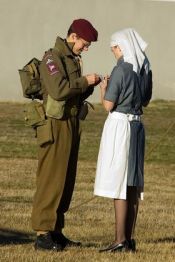 restored Willys Jeep and an old aeroplane engine. Since then at successive shows, there has been an increased number of military vehicles on show. In 1996, Sir Tim Wallis recognised that in order to control the running of the military vehicle group, an owners committee should be formed, and the group became known as Warhorses at Wanaka.
The group was quickly becoming very much an attraction as re-enactment groups joined with the Warhorses to put on military displays with period uniforms, weapons, vehicles and all manner of military paraphernalia. Each year, the group combines to focus on a theme; i.e. Pacific war, France and Germany, the Russian Front and so on. A total of 78 vehicles attended the 2000 show. With the ever diminishing availability of ground space, the then Chairman of the Warhorses at Wanaka Mr. Bruce Cameron, who has been involved from day one, said they have had to limit the number of vehicles.
The vehicles and the re-enactors combine to make a realistic pageant which is designed to work in with the aerial displays being played out overhead by the Warbird pilots. Warhorses recognize that, with the large number of visitors not only from New Zealand, but all over the world, they have an obligation to make their displays and re-enactments as correct, authentic and professional as possible.
Warhorses today is a combination of a variety of groups of enthusiasts interested in the preservation of not only military vehicles, equipment, weapons and uniforms, but their use, and the history associated with the various theatres of war. Those involved, however, do enjoy the firing of the weapons and field guns, using blank ammunition of course.
The Royal Australian Air Force provides air and space power for Australia's security. It is the youngest of the three armed Services in the Australian Defence Force (ADF), the uniformed part of the Australian Government Department of Defence. The Royal Australian Air Force is the second-oldest air force in the world (after the British Royal Air Force). Founded during World War 1 as the Australian Flying Corps of the Royal Air Force, the Royal Australian Air Force was established as a separate organisation in 1921. The Air Force peaked at over 182,000 personnel and 6,200 aircraft at the end of World War 2 - making us the fourth-largest air force in the world at that time (after the USA, USSR and UK). They have since served with distinction in Korea, Malaya, Vietnam, Afghanistan and Iraq. They are also very proud of their role in peace-keeping and humanitarian missions throughout the world, including Bougainville, Cambodia, East Timor, Indonesia, Pakistan, Papua New Guinea, Rwanda, Solomon Islands and Somalia.
Air Force Headquarters is located in Canberra. Air Force employs about 13,500 men and women, supported by 2,800 Air Force Reservists and 900 civilian public servants, at 11 major bases and a host of offices across Australia. Air Force works closely with the Navy, Army and allied forces. Of the sixteen types used by the Royal Australian Air Force, which range from super-sonic fighters and bombers to heavy and light transport aircraft, three are represented at Warbirds Over Wanaka 2008.
C-17 Globemaster Heavy Transport
The C-17 Globemaster is a high-wing four-engine heavy transport. It has three times the carrying capacity of the C-130 Hercules, allowing Australia to rapidly deploy troops, combat vehicles, heavy equipment and helicopters anywhere in the world. The Globemaster is large enough to transport the M1A1 Abrams tank, Black Hawk, Seahawk or Chinook helicopters, three Tiger armed reconnaissance helicopters or five Bushmaster infantry vehicles.
F-111 Strike Aircraft
The F-111 is a twin-engine swing-wing aircraft. It can take off and land at relatively low speeds with the wings swept forward, then fly at more than twice the speed of sound with its wings tucked back. It can fly close to the ground at supersonic speeds, following the terrain to avoid detection, striking day or night in any weather. Its Pave Tack targeting system can locate targets at night and in bad weather and provides laser designation for laser-guided weapons. The radar warning system detects incoming radar emissions and alerts the crew to potential surface or air attacks. It is affectionately known as the 'Pig' for its ability to hunt at night with its nose in the weeds, thanks to its terrain-following radar.
DHC-4 Caribou Light Transport
The Royal Australian Air Force DHC-4 Caribou is a versatile tactical light transport aircraft, capable of very short take-off and landings on unprepared runways. Its main operational role is tactical air transport in support of the Australian Army. The Caribou is operated by No 38 Squadron from RAAF Base Amberley, near Brisbane, and RAAF Base Townsville. It is the last piston-engined aircraft in the Air Force and is our only aircraft to employ the Low Altitude Parachute Extraction System (LAPES), where up to 2000kg of sled-mounted cargo is extracted from the aircraft by a parachute from a metre above the ground. Although introduced in 1964 and employed in the Vietnam War, the Caribou is still recognised as one of the most capable short-haul transport aircraft in the world. Three Caribou will be appearing at Warbirds Over Wanaka 2008.
2008 will be a significant milestone in the progress on Air Force aircraft upgrade projects. While none of the projects actually finishes this year it is certain that we will begin to see some of the fruits of our labours. When completed, the projects will bring huge benefits to our Air Force in terms of capacity and capability.
C-130 Life Extension programme: The RNZAF's five C-130 Hercules aircraft are undergoing a progressive life-extension upgrade. This includes a centre wing refurbishment, a major rewire and new flight deck instrumentation. This also means replacement of the communication and navigation systems with more modern systems to ensure the aircraft continues to comply with evolving air traffic control regulations. The first C-130 upgrade is expected to be complete in mid-2008.
Boeing 757 Modification Project: The Air Force's two Boeing 757s are undergoing a series of modifications to allow the carriage of both cargo and passengers and ensure navigation and communication systems meet future regulatory requirements. The modifications will greatly improve the B-757's capabilities and will include:
The installation of a main deck cargo door
Strengthened floors
New cargo handling system and cargo barrier net
Updated military and civil communication and navigation systems.
The first Boeing 757 is due back in New Zealand in early 2008 and the second will return home later in the year (2008).
P-3K Upgrade Project: The Air Force's six P-3K Orion aircraft are undergoing a systems upgrade to enhance their capability over both land and sea. Improving the aircraft's communications and navigation equipment as well as their mission systems. The upgraded aircraft will be re-designated P-3K2. The mission systems upgrade involves the installation of new imaging radar, electronic sensor equipment (video and infrared camera) and data management system. The upgrade of communication and navigation systems will ensure the aircraft comply with evolving air traffic control regulations. The first fully upgraded P-3K is expected to arrive in New Zealand in the second half of 2008 while the last upgrade is due to be completed in late 2010.
NH90 Introduction: The RNZAF is purchasing eight NH90 helicopters to replace its aging fleet of 14 Iroquois. The NH90 is a modern helicopter designed to meet current and future requirements and is an excellent long-term investment. The first NH90 is expected to be delivered in 2010, the remaining NH90s are due to arrive between 2010 and 2011. The NH90 will considerably improve the RNZAF's capability to conduct military, counter-terrorism, disaster relief, search and rescue, fire fighting and counter-drug operations. It will offer significant performance improvements over the venerable Iroquois helicopter, currently operated by No. 3 Squadron RNZAF.
Training/Light Utility Helicopter Replacement: The Air Force's five remaining Bell Sioux training helicopters will be replaced with new Training/Light Utility Helicopters (T/LUH) to train pilots and helicopter crewmen in basic and advanced helicopter flying, to ensure adequate progression to both the SH-2G and the NH90, and provide a light utility helicopter capability to complement the NH90. The Sioux has served the NZDF well but is no longer an appropriate training platform for modern military helicopters, which incorporate much more advanced technology.
It was sitting there on the tarmac as I walked out. What a picture it made, standing there in a blast bay at this mighty RAF Fighter base. I stood still for a moment and just looked. This aircraft was belligerence personified. From the elegant rudder to the four short 20mm cannons the destructive power was obvious. Designed only to kill, it was ready and eager to carry a young pilot into combat. It seemed immense with that enormous 2,000 + hp Napier Sabre motor taking up so much of its total being. I walked closer, my parachute over my shoulder. One of the ground crew stood on the wing with the canopy open ready for me. I handed the parachute up to him and he placed it in the cockpit. 'First solo on Hawker's new effort he said"? He grinned at me. "Lucky bugger" he added. I grinned back.
My left foot entered the lowered stirrup the right went into the foot recess in the fuselage and I was into the cockpit. I settled down, everything seemed familiar, this was, after all, the third Hawker aircraft type I had flown. The airman dropped the straps over my shoulders and I buckled up. He jumped down and I started my cockpit drill.
30 minutes earlier I had been standing with my Flight Commander, Frank Murphy in the pilots dispersal at Tangmere. I was with 486 (NZ) Squadron. It was early January 1944. You can give that new aircraft a run "Staff". You haven't flown a Tempest yet have you?' said Frank and he smiled at me. 'No Sir, I'm looking forward to it.'
'You'll find it very different to the Typhoon. I think she's a great improvement. Just watch that violent swing to the right on take-off. So much torque from that giant prop. Remember the left trim!' Do something stupid and she will kill you faster than you can think.
I was remembering that bit of advice as I fired the starting cartridge. The motor started like a volcano. I waved to the airman, released the brakes and moved out to the end of the perimeter track and sat watching the control tower. The green light exploded in my face giving me the all clear. I taxied onto the runway and turned into wind. A sign should have said 'Heaven this way.' This was heaven for me.
I opened the throttle fully. +7, 3,700 revs and like a charging bull that mighty aircraft leapt away as the powerful twist to the right began, pressing me against the rear support. I had applied full left trim and was giving her full left rudder. The speed increased, my control became more positive and I eased her tail up from the bitumen I felt the air below me as she lifted from the runway still exerting some swing to the right. Up went the undercart, confirmed by a mighty clunk. There were angels pushing as this mighty raptor moved towards the heavens: she was a rocket into the sky, climbing effortlessly.
Easing the throttle back the motor quietened to a steady throb and I was there, thrilled like a debutante on her first date, I was in love. I looked at the glorious elliptical shape of the wings. From the cockpit the visibility was perfection just a touch on the rudder and I could see under the tail. I belted along that Sussex Coast climbing a few thousand feet. I tried some steep turns, I pulled her nose up till she reached the stall then quickly dropped her nose and recovered.. Twisting and turning, skidding right and left I had a ball. What a dream machine.
I flew inland over that glorious Sussex countryside. Lifting her nose we went up to !8,000 feet like a lift, we hung for a moment then I turned her onto her back. We dropped together out of the sky. With lots of throttle applied I headed for earth. In no time the clock read 550 mph!! It seemed to be still increasing. I eased back on the stick and this 'Aristocrat' answered my suggestion. The startling Zoom climb began. In a minute or two we were back at 15000 feet. At any flying speed and in any position I had complete control. What a dream.
An hour seemed to pass as minutes. The fuel also passed at a similar speed as I burst through the sky in this steel Falcon. 400 mph was a breeze. Time to return. Tangmere was in sight. I made my approach dropping like a mallard onto his pond. The wide under carriage created stability touching down like a butterfly.
Murph was waiting at the dispersal watching me land. 'How .was it Staff? No problems? Did you give her a good workout?' I'd had some operational experience on the Typhoon but this was something else. 'It was just heaven," I grinned. "I could have stayed up there all day. God isn't she something? I looped and rolled, twisted and turned, climbed and dived, what an impressive dive and what a zoom climb. I felt that I could out climb the Flak."
Murph just smiled. I found out quickly that I was being a bit hopeful there. She wasn't quite up to that. I looked out the open door and studied the Tempest. I felt that if it could speak it would have said- 'Fly me well and together we'll win. I'll bring you home.' My confidence was total.
Flight Lieutenant Jack Stafford DFC
By the 1960s, New Zealand's defence depended on a system of collective security. Meaning if we support our allies, they will help defend us. Our most significant ally was no longer Britain alongside whom we had always fought but the United States of America and Australia. With these allies we fought to defend our freedom in the Pacific in WW11 and with whom we signed the ANZUS Treaty in 1951.
Unlike the US and Australia which accepted the need for a significant military engagement in Vietnam with few doubts, New Zealand's National Government, and in particular Prime Minister Keith Holyoake, were more cautious. As a result, NZ's involvement was initially more of a psychological symbolic contribution. Even at the height of the NZ involvement in 1968, the force was only 540 men in theatre.
While New Zealand and other allies came under increased pressure to provide combat assistance, there was a major concern in Wellington that to provide infantry in Vietnam would seriously erode the commitment to combat terrorism in Malaysia where the forces were already deeply involved in the confrontation.
Failing to make a token contribution to the allied effort in Vietnam would surely have brought into question the basic assumption underlying NZ's post-war national security policies. The potential adverse affect on the ANZUS Alliance of not supporting the US and Australia in Vietnam, was of paramount importance.
The subsequent compromise combat involvement began with the arrival in Saigon of 161 Battery, Royal New Zealand Artillery equipped with four L5 Pack Howitzers in July 1965. The unit was inserted into theatre by Royal New Zealand Air Force C130 Hercules aircraft; the first time a New Zealand Unit had been deployed to a war zone with full equipment, by air. The Battery was later expanded to six Howitzers. In April 1967 and Confrontation ended, Victor Company then Later Whiskey Company of the Royal New Zealand Infantry Regiment were deployed from Malaysia into the Vietnam conflict. 1967 also saw a medical team comprising Royal New Zealand Navy and Royal New Zealand Air Force personnel inserted to provide medical and surgical assistance to the South Vietnamese civilian hospital units.
In the early days of the war, the RNZAF was mainly involved in the transport role. Using C130 Hercules and even the venerable B170 Bristol Freighter aircraft, the RNZAF carried NZ personnel equipment and stores into and out of Vietnam. A number of RNZAF helicopter pilots were made available to No. 9 Squadron Royal Australian Air Force to fly the UHIH Iroquois helicopter, and then in 1968, the first two of fourteen RNZAF Strike pilots served with the 7th US Air Force as Forward Air Controllers (Target Markers). They flew Cessna Bird dog O1s, Cessna 337 O-2As and OV10 North American Broncos. One ex RNZAF Strike Pilot flews Canberra Bombers with the RAAF in theatre. Two NZ Army pilots flew the US Army's Bell47 observation helicopters.
By 1972, most of the Kiwi combat force had been withdrawn and when the Norm Kirk Labour Government took office it immediately withdrew the training teams as well. Altogether a total of 3890 New Zealand military personnel had served in the Vietnam War; 36 Army and one Air Force were killed, and 187 wounded.
The Vietnam War marked a "sea change" in NZ's foreign policy and security arrangements. It seemed the official thinking had shifted, and had to rethink the stark assumptions about the menacing spread of Asian Communism, and forward defence in South East Asia. Today we honour all Vietnam Veterans and salute those who died. Some of the Aircraft types used in the Vietnam War are on parade today.
From Baffins To Mustangs - The Early Years
These days most people identify No.3 Squadron with helicopters. But the Squadron was first formed at Harewood in 1941 and equipped with Baffin aircraft. The two-seater Baffin wasn't the ideal aircraft for general reconnaissance because the pilot also acted as navigator.
Thankfully the Baffin's were phased out by the end of 1941 and replaced by Hudsons which had ample room for a navigator. No.3 Squadron was the first to operate from Guadalcanal's newly liberated Henderson Airfield on 23 November 1943. The Hudsons flew up to seven patrols a day searching for enemy shipping, particularly submarines, trying to resupply the Japanese Army remaining to hold on the north of the island.
Ashburton-born George Gudsell was the first RNZAF pilot to arrive at Henderson. He was sent on patrol soon after he arrived. The Squadron was to complete three operational tours of the South West Pacific, the latter with Ventura medium bombers. During the tours it was based at Espritu Santo, Guadalcanal, Bougainville, Emirau, Green Island and New Britain. In recognition of its contribution No.3 Squadron was presented with a Squadron Colour.
Post War
In 1949, after a referendum, the Government introduced Compulsory Military Training (CMT) and No.3 Squadron was made a Territorial Air Force squadron based at Christchurch's Wigram airfield. The squadrons was given a fighter/ground attack role initially flying Tiger Moths and then in 1951 and 1952 was equipped with American built P-51 Mustang fighters which had been delivered in 1945 but never put into service due to the end of hostilities in the Pacific. The Mustang was a fast, Merlin-engined, versatile fighter that certainly made the squadron step up into one of the finest aircraft ever built. Economic considerations meant that No.3 Squadron, the three other Territorial Units and No.6 Maritime Squadron were disbanded in 1957.
Rotors Replace Wings - Changing Face
In 1965 No.3 Squadron reformed at Hobsonville in Auckland. This time it had an entirely different face - rotors instead of wings. It had become a helicopter squadron, operating Iroquois, Sioux and Wasp helicopters. For the next 47 years its operations included cyclone relief in the South Pacific Islands; assistance to researchers and scientists in Antarctica; search and rescue operations; flood and storm rescues; participation in exercises in Australia, Vanuatu, South East Asia and the United Kingdom.
Vietnam
You won't find much in the history books about New Zealand's commitment to the Vietnam War. But in the four and a half years from July 1967 to December 1971 a total of 16 No.3 Squadron helicopter pilots served with the RAAF's No. 9 Squadron in Vietnam. The ANZAC Squadron operated from Vung Tau supporting the 1st Australian Task Force at Nui Dat, about 40 kilometres south-east of Saigon.
Sinai Peacekeeping
In March 1982 135 New Zealand and Australian Air Force personnel and 10 Iroquois helicopters (two New Zealand and eight Australian) were assigned to peacekeeping operations in Sinai, Egypt. The Multinational Force and Observers (MFO) rotary unit provided transport for observers, verification and reconnaissance missions throughout the four treaty zones and logistics support flights to battalions attached to the MFO. The RWAU logged over 16,000 air hours without a single accident.
Four years later on 31 March 1986 the ANZAC RWAU was withdrawn and the role taken over by the Canadian Defence Force. Thus closed a chapter in No.3 Squadron, and the RNZAF's largest scale peacekeeping operations.
Bougainville
In early November 1997 the New Zealand Government agreed to provide a Truce Monitoring Group (TMG) to the war-torn island of Bougainville. To meet this task the New Zealand Defence Force raised a tri-Service contingent. A No.3 Squadron Helicopter Force Element formed by a detachment of three Iroquois and personnel served in Bougainville from December 1997 to April 1998.
Antarctica
During the 1980s No. 3 Squadron began operating on the Antarctic Continent in support of the New Zealand Antarctic Scientific Exploration. The Huey's were dubbed "Orange Roughys" as they were painted Dayglo Orange.
Timor Leste
In late September 1999 a detachment of six Iroquois and 140 Air Force personnel were committed to Dili as part of the multi-national military force. The Iroquois began operations on 1 October 1999. In mid December the Iroquois detachment moved from Dili to Suai on the western coast of Timor Leste. No.3 Squadron's five Iroquois helicopters provided support to the New Zealand infantry battalion based in Suai province. After the 42 month deployment the Squadron received a Meritorious Unit Citation from the Australian Chief of Defence Force. No.3 Squadron returned to Timor Leste in April 2008 following violent clashes in the embryonic state.
Solomon Islands
After only six months back in New Zealand, No. 3 Squadron was again called at short notice to support an overseas mission, the Regional Assistance Mission to the Solomon Islands (RAMSI). An Iroquois detachment served at Henderson Field on Guadalcanal (where, incidentally, a No. 3 Squadron detachment was based in 1942-43) from May 2003 to May 2004.
Future Directions
On 31 July 2006 Defence Minister Phil Goff signed a contract with NH Industries for the purchase of eight NH90 helicopters to replace the Iroquois. In the meantime, the RNZAF will carefully manage the Iroquois fleet to ensure the Rotary Wing Transport Force continues to meet its obligations. The Sioux training helicopter is due for replacement and it is expected that a contract will be announced soon. The replacement will fulfill a training role leading to conversion to the NH90 but will also be used as a utility helicopter performing some of the task now performed by the Iroquois.
Additional Roles
Tactical air mobility
Counter terrorist support
Very Important Person (VIP) transport
NZ Police assistance
Search and rescues
Aero medical evacuations
Civil defence support and
Disaster relief in NZ and the South Pacific.
Other Facts About No.3 Squadron Today
Utility Flight: Utility Flight operates 14 Bell UH-1 Iroquois helicopters, more commonly known as Hueys. The Flight consists of about 35 pilots and 15 crewmen. The Huey provides Tactical Air Transport in New Zealand and undertakes a wide variety of tasks. The Huey can carry up to nine passengers, in addition to the normal crew of three. The Flight's primary role is battlefield support for the New Zealand Army. This includes troop and gun movement, re-supply and logistical support along with medical and casualty evacuation.
Training Flight: The Training Flight was originally based in Christchurch and in 1993 moved to Hobsonville. Pilot students arrive at No.3 Squadron after completing the Airtrainer course at Pilot Training Squadron and the Multi-engine Basic course on the B200 Kingair at No.42 Squadron. They are then awarded their wings before posting to No.3 Squadron for the Helicopter Basic Course. They then move on to the Iroquois Pilot Conversion Course, or to No.6 Squadron for Sea Sprite Navy helicopter conversion.
Maintenance Flight: Maintenance Flight is the largest of the three flights, made up of about 90 personnel responsible for the maintenance of all aircraft flown by No.3 Squadron. They are often required to deploy into the field and overseas.
Career Opportunities: The helicopter is the most flexible aircraft in the Air Force's inventory, and No.3 Squadron's role reflects this. The Squadron has arguably the most interesting, consistently varying and demanding flying in the Air Force. Careers are many and varied - from Pilot and Crewman to Mechanic and Supplier. No.3 Squadron operates as a network using people with different areas of expertise to get the job done.
Number 3 Squadron Crest: The Squadron crest that resides on the Iroquois shows a Maori warrior poised for attack. The warrior has become colloquially known as Ngaruwahia Ned and was designed by former Corporal of No.3 Squadron, Mr Ross Cleverley of Christchurch. The motto reads 'kimihia ka patu', which has a literal translation of 'to look for' and 'club'. This is interpreted to mean 'seek and destroy'.
The first public display of the 80 inch Land Rover was at the 1948 Amsterdam Motor Show. This innovative vehicle was thought to only have been a short term project to keep the Rover Car Company busy whilst waiting for Rover car sales to climb after the war years. This rugged simple go any where machine was the brain child of brothers Maurice and Spencer Wilks of the Rover Car Company.
The first prototype was built in the English summer of 1947. A further 48 examples were built to conduct trials and undergo appraisals. Due to the post-war shortage of steel and reasonable supplies of aluminium, a simple light and corrosion proof aluminium body was fabricated and mounted to a strong box section steel chassis. Many of the components for this ingenious vehicle were taken from Rover cars. Amazingly the time from conception of the idea to production was only 12 months.
Land Rover vehicles were model typed by the distance between the centre line of the front axle through to the centre line of the back axle. The series one short wheel base Land Rovers were manufactured between 1948 and 1958 and were supplied as 80 inch 1948-53, 86 inch 1954-56, and 88 inch 1956-58. In 1954 a 107 inch long wheel base vehicle was released and soon after a 109 inch.
The Land Rover soon became the vehicle of choice for military and agricultural users as well as recovery and emergency organisations. By 1959 the 250,000th Land Rover had had rolled off the production line. In these early years here in New Zealand the Land Rover was well received by farmers and by the military.
The Series Two Land Rover was released later in 1958, the body style changes made for this model fundamentally are the basis for today's Defenders. This build stayed with Land rover until the last of the Series Three model in the late 80s.
In 1970, Land Rover released the all new Range Rover, with a new aluminium V8 engine and full time four wheel drive system with central diff lock. All these amazing mechanical attributes with a luxurious interior within a new body made this vehicle at its debut, the most advanced luxury 4WD of the day.
The Range Rover was the first and only vehicle ever displayed at the Louvre in Paris as an example of automotive art. The 25 year production journey that this vehicle took until the new model was released in 1996, will probably never be repeated by any other vehicle. It set the parameters for off road performance and comfort levels other vehicle manufacturers could only wish for.
1990 saw the release of the Discovery, a vehicle aimed at the family 4WD market priced below the Range Rover but with many of the Range Rover mechanical features. Still having the off road ability that Land Rover engineers made a prerequisite of vehicle design learned from the success of early Land Rovers all those years ago, the discovery remains supreme.
