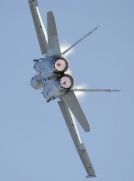
Four F/A-18 Hornet fighters from the Royal Australian Air Force were among the many 'stars' lining up to give aerobatic displays to the thousands of spectators at this year's international airshow. The aircraft were in New Zealand on exercise with the RNZAF.
|
Rob Fox - photography |
 |
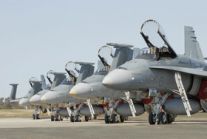 |
Developed originally for the US Navy and Marine Corps, the multi-role Hornet fighter is one of the world's most advanced aircraft. It can achieve a speed of 1915km/h (1190 mph) and fly above 45,000ft.
The fighters have been fully operational with the RAAF for over 20 years and are capable of carrying a range of sophisticated missiles and laser guided bombs. They are designed to perform day or night air strikes over land and sea using precision-guided weapons and perform all roles of counter air.
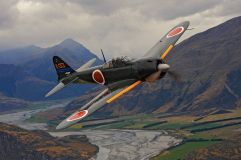
A6M3 Japanese ZeroOur star attraction for 2010 was the Japanese Zero, a remarkably manoeuverable, light weight aircraft that was the scourge of the Pacific during WWII. It did not carry a lot of heavy armour, however, and when compared to the American-built fighters it was pitched against, was not particularly fast. In combat the only chance the allied forces in the Pacific had was to get in, get one good shot at a Zero then get out of there fast. The single-seat fighter at the airshow was designed to be carrier-based and had folding wing tips and an incredible long range of over 3000km. Zeros were powered by a Nakajima NKIF Sakae 14 cylinder air-cooled radial engine with 1,130hp although this example has a Pratt and Whitney R1830 engine with 1200hp. Its maximum speed is around 620kmhr (a P-51 Mustang can travel at over 700kmhr) and its fully loaded weight only 2243kg (a Mustang weighs nearly twice that). The Zero, whose name is derived from its type designation after the year in which it was put into service (1940), was produced in great numbers by the Japanese and deployed in battle on Guadalcanal. Zeros were rushed to New Guinea and the Solomon Islands to provide cover over the supply route to Guadalcanal. Over 40 Zeros were among the 353 aircraft launched from aircraft carriers during the devastating attack against the US at Pearl Harbour, Hawaii in 1941. This aircraft was recovered from Babo in Guinea in 1991, partially restored from several machines in Russia, then brought to the United States for completion. One of only three airworthy examples, it is housed at the Santa Monica Museum of Flying in Southern California. |
 |
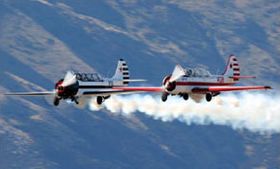
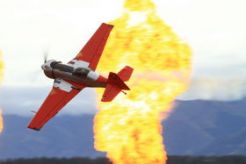
The Return of Jurgis KairysThe "flying entertainment package" concept was designed by Jurgis Kairys to perform a new and refreshingly different style of airshow display. This aircraft, on a diversity of flight paths produce lots of noise, lots of smoke and what Jurgis himself calls, 'well organized chaos.' Jurgis was born in Siberia and brought up in Lithuania. He graduated as an aircraft engineer, in airframes, and commenced flying training. Excelling in aerobatics, Jurgis became a member of the elite National Team at the Kaunas Flying Club in Lithuania. This aircraft is the Juka designed by Jurgis Kairys,and the Yak 50, different airframes with the only resemblance being the 9 cylinder M14P radial engine. |
 |
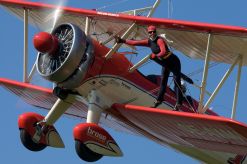
Peggy Krainz – German Wing-Walker and Stunt-Woman since 1999...Peggy Krainz and Friedrich Walentin (Airshow Pilot and Peggy’s partner) came from Germany with their Boeing Stearman E75 – an open cockpit two seater biplane - powered by a 9 cylinder – 450hp Pratt & Whitney radial, manufactured in 1942. With a 33ft wingspan and cruise of 83kts the Stearman aircraft is renowned for aerobatics and Peggy’s Stearman is also modified for Wing Walking. Having completed more than 600 Wing-Walking displays for Airshows, TV and special events, Peggy has operated her own Wing-Walking Team since 2005. Peggy has her Private Pilot’s Licence and is also an aerobatic Flight Instructor. |
 |
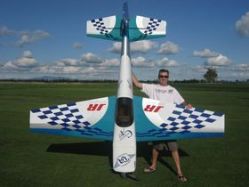
Model Aircraft Extra 260
Frazer Briggs flew his 40% scale Extra 260 model aircraft. Specs: 3m wingspan, 150cc motor, all fibreglass and carbon-fibre. Manufactured by Composite-ARF, there are people all over the world flying the same model. |
 |
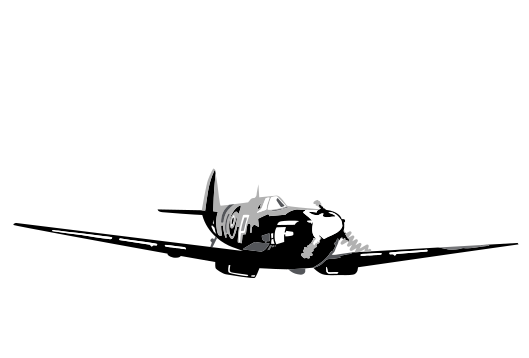
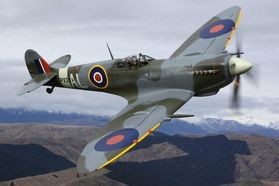
Supermarine PV270 SpitfireAl Deere's Supermarine PV270 Spitfire was one of the most famous fighters in WW11. New Zealand’s only airworthy Spitfire fighter aircraft. It is one of only about 45 airworthy examples worldwide. This Spitfire is the first to be fully restored in New Zealand and is owned by the family of renowned Kiwi fighter pilot Alan Deere. Air Commodore Deere, who was a highly distinguished pilot, served with the RAF for forty years. The Mark IX Spitfire was built in 1944 and served with the Royal Air Force in Italy. The ‘AL’ on the fuselage has been added to represent the Spitfires flown by his uncle in wartime, he said. Spitfires flown by the Royal Air Force gained legendary status during WWII for their success as fast and formidable front-line fighters, particularly during the Battle of Britain.
|
 |
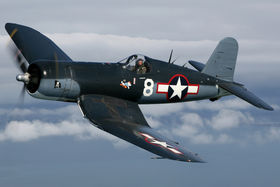
Goodyear FG1D CorsairThis aircraft is powered by a 2000hp Pratt and Whitney radial engine and can cruise at 44,000ft. It can travel at 450mph with a range of 1500km without refueling. Nicknamed “Whispering Death” by the Japanese because of its exceptionally quiet approach, the Corsair soon helped gain air superiority. Corsair NZ5648 is the last remaining of the 400 operated by the RNZAF during WWII. |
|
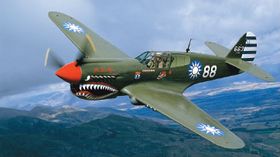
Curtiss P-40 KittyhawkFirst flown in 1938, the Curtiss Kittyhawk operated in almost every theatre of war in WWII. The RNZAF operated 297 of these fighters in the Pacific during WWII and were responsible for 99 Japanese aircraft destroyed. Replaced by the Corsair in 1944 the P-40 returned to New Zealand as an advanced fighter trainer. |
|
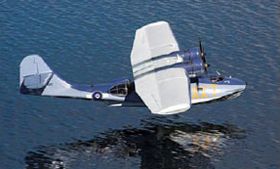
Consolidated PBY CatalinaThe RNZAF operated 56 Catalinas in the Pacific during WWII. Stabilizing floats which, when retracted in flight, formed streamlined wing tips, were unique innovations which made this aircraft ideal for use in the surveillance, anti submarine, air/sea rescue and convoy patrol roles. ZK-PBY, flown by the Canadians in WWII, was purchased by the Catalina Group and arrived in New Zealand in 1994. |
|
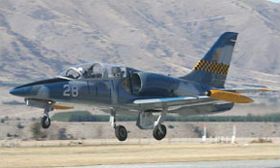
L-39 AlbatrosThe Czechoslovakian L-39 was built as the successor to their earlier trainer, the L-29 Delfin and first flew on 4 November 1968. The idea of the design was to marry an efficient, powerful turbofan engine to a sleek, streamlined fuselage, resulting in a strong, economical performer which would become the next standard jet trainer for the Warsaw Pact. Full-scale production was delayed until late 1972 due to apparent problems with the design of the air intakes, but these difficulties were overcome and the type went on to be a great success with the Soviet, Czech and East German air forces, among others. |
|
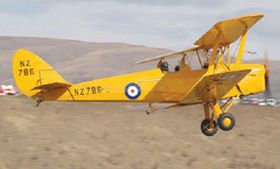
Havilland DH82A Tiger MothThe most famous of all de Havilland aircraft in this country is the Tiger Moth. Flown in its hundreds in the Air Force, topdressing, aero club, gliding club and private use it was once the primary trainer for NZ fighter pilots. It is being seen in increasing numbers as more long term rebuilds take to the air. |
|
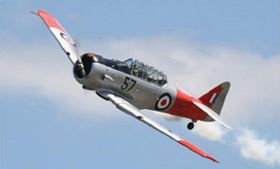
North American HarvardIn RNZAF service as a pilot trainer for more than three decades the Harvard was first flown in 1937. Known as the Harvard in the British Commonwealth, T-6 Texan in the USAF and SNJ by the US Navy, over 21,000 examples were built. The Harvard was used as the primary trainer for most Commonwealth aircrew during WWII, after they had flown solo in the Tiger Moth. Fully aerobatic, it was a delight to fly, but not too easy for the novice who one day would move onto single seat fighter aircraft. |
 |
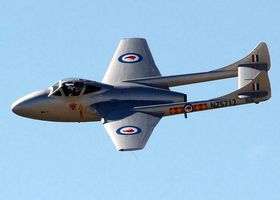
de Havilland VampireThe Vampire was the UK's first single-jet fighter, the prototype flying in September 1943. Entering service with the RAF in 1946 the type also became the RNZAF's first operational jet aircraft. The first Vampires arrived in 1951-52 and went to form No.14 and No.75 Squadron at Ohakea. Remaining in service until 1972 when replaced by the Strikemaster the type was flown by 21 countries including Australia - where 109 were built under license. |
 |
Yakovlev Yak-52Designed in Russia and manufactured in Romania, the YAK-52 emerged as a further development of the YAK 18-A. Not used as a military aircraft, the YAK-52 was used by paramilitary and sport flying groups throughout the Soviet Union. Stressed to plus 7-minus 5 Gs and powered by a 360 hp Vendeneyev M-14 P nine cylinder radial engine, the aircraft makes an ideal aerobatic trainer and performer. |
|
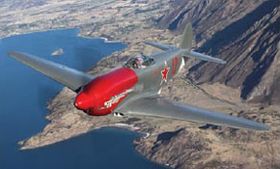
Yakovlev Yak 3-MNicknamed "Dogfighter Supreme", the Yak 3 was the ultimate refinement in Soviet wartime fighter development. The smallest and lightest combat fighter of WW11, upon entering combat with the Luftwaffe. It was found to be so much superior to the Focke-Wulf 190 and the ME-109 that a signal was sent to all squadrons saying, "avoid all combat below 10,000 feet with any Yak fighter lacking an oil cooler under the nose". |
|
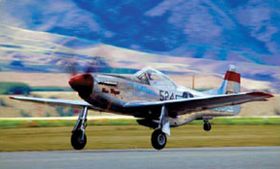
North American P-51D MustangThe British inspired, American built Mustang was one of the most potent and versatile fighters of WWII. Operated as a long range escort and in the close air support role. It became the first fighter capable of accompanying American bombers all the way to Berlin and back. When first flown in 1940, it was powered with an Allison engine but later models were powered by a Packard Merlin, which provided it with considerable extra power at higher altitudes. It became known as the "Cadillac of the skies". |
|
The Royal New Zealand Air Force showcased aircraft, and also the professionalism and dedication of the men and women who serve our country. The red, white and blue parachutes, the RNZAF’s elite Kiwi Blue parachute team synchronise their descent with seemingly effortless ease. The team has carried out displays overseas in Australia and the United Kingdom, making them a truly international act.
A P-3K Orion, used in maritime search and rescue and the C-130 Hercules, the Air Force’s transport aircraft joined RNZAF Harvard in the mass Harvard fly past. In addition we saw the rotary wing fleet of Iroquois helicopters used in Search and Rescue missions and New Zealand Defence Force exercises and operations at home and abroad; together with the Sioux helicopters used for pilot training, and the impressive Seasprite.
For those in the crowd the RNZAF displays are always a highlight, showing that the Air Force was an agile, dedicated and professional organisation.