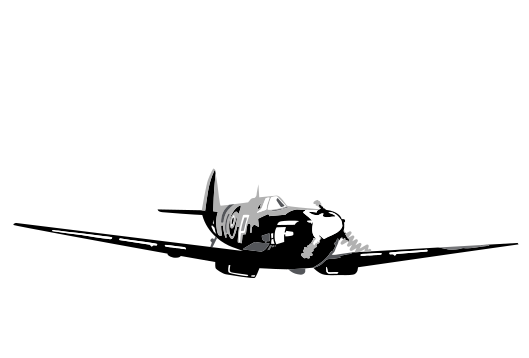
An overnight dusting of snow on the mountains around Wanaka provided an attractive background for photographers as warbird aircraft practised in preparation for this weekend's Warbirds Over Wanaka show.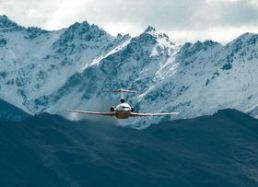
The opportunity to meet retired NASA Astronaut Buzz Aldrin would be a huge draw card for many people. Dr Aldrin, who arrives in Queenstown on Friday, had said he was excited to be coming to the show. Dr Aldrin was a crew member on Apollo 11 in July 1969 and made history when he and Neil Armstrong walked on the moon. He has made a lifelong commitment to man's efforts into exploring space and has documented his experiences in an autobiography and documentary, as well as writing two space novels.
He will visit Walter Peak Station across Lake Wakatipu from Queenstown on Friday, before being driven to Wanaka. During the airshow he will be interviewed over the public address and will do 'walk-abouts' among the crowd. The former jet pilot also planned to take a scenic flight around Mt Aspiring before departing Wanaka on Monday.
Lithuanian aerobatics star Jurgis Kairys and warbird pilot Ray Hanna will also perform at the show. Early weather predictions from the Met Service were for fine conditions on Friday and it is hoped these will continue for Saturday and Sunday's action.
Jurgis Kairys Confirmed for Warbirds Over Wanaka 2004.Top Lithuanian aerobatic pilot Jurgis Kairys has been confirmed for this years Warbirds Over Wanaka Airshow. |
 |
Ian Tulloch to Appear at Warbirds Over Wanaka 2004
Warbirds Over Wanaka will be host to a remarkable racing truck this Easter, General Manager Gavin Johnston announced today. Mr Johnston has confirmed Ian (Inky) Tulloch and his super-truck will be burning rubber down the Wanaka tarmac. Inky is expected to wear through a whole set of tyres during his demonstration.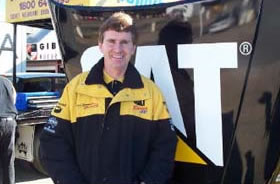
Since Inky first raced his Freightliner in 2001 the combination has been virtually unbeatable on the Australasian super-truck circuit. Inky has been placed in the top three of both the New Zealand and Australian Truck Racing Series since 1998, and currently holds the race lap record, for trucks, at every track on both sides of the Tasman.
"Over the years we have had various displays by different facets of the motor sport industry - from Mark Skaife and his V8 Commodore, through to the late John Brittens motorcycle victory over a Hughes 500 at the 1994 show. The confirmation that Inky will display at Warbirds Over Wanaka 2004 is another highlight of this Easters show. The biennial helicopter/aeroplane/car race is anticipated by many people every two years and I haven't decided who I'm going to put my money on yet!" said Mr Johnston.
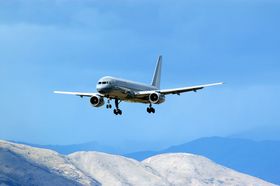
The latest addition to the Royal New Zealand Air Force (RNZAF) will make its debut at the Warbirds Over Wanaka Airshow in Easter 2004. A Boeing 757 jet transport will present itself to the expected record crowd at the show from April 9th -11th this year. "Every Airshow the RNZAF really get in behind the event and support us, and this year is no exception. After having the Boeing 727, which was one of the highlights of Warbirds Over Wanaka 2002, I am pleased to announce the 757 will be here. It is guaranteed to captivate the crowd even more than the 727." said Airshow General Manager Gavin Johnston.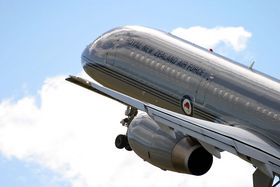
The two Boeing 757 were purchased from Dutch airline Transavia and arrived in New Zealand in May and July 2003. At just under 50 metres long, the Rolls Royce powered 757 has a cruising speed of 850kmph, and can carry a maximum load of 32,000kgs. The two 757s are operated alongside five C130 Hercules by No. 40 Squadron based at Whenuapai in Auckland. No. 40 Squadron provides a range of strategic and tactical air transport roles throughout New Zealand, the Pacific region and around the world.
Accompanying the 757 will be a Hercules, two Iroquois helicopters, the Red Checkers aerobatic team, an Orion, the Kaman Seasprite Naval helicopter, and the Kiwi Blue Parachute Team. They have all performed at Warbirds Over Wanaka previously and Johnston is thankful for their support. "To know that we can rely on the Air Force each year to pull out all stops at the Airshow is great. From the adrenalin pumping Kiwi Blue jumpers, to the high tempo Red Checkers displays, then followed by the formidable Hercules and Orion aircraft, people get to glimpse all facets of the RNZAF."
After five highly successful years of displaying in Europe, the BREITLING FIGHTERS warbird display team will appear for their final show at the Warbirds Over Wanaka International Airshow 2004 at Easter, Warbirds Over Wanaka General Manager Gavin Johnston said today. "The organisers of the event are delighted to announce that Europe's top warbird display act will be appearing at the show and that two of their Warbird aircraft are already on a ship bound for New Zealand".
"This team has been a huge success in Europe and comes to New Zealand because of the special relationship between Sir Tim Wallis the founder of Warbirds Over Wanaka and Ray Hanna who owns the aircraft and leads the team", he said. 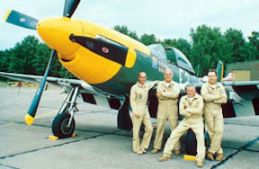
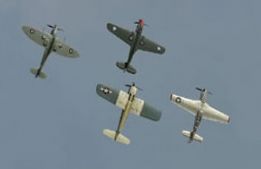
The Breitling Fighters Team has displayed to over 25 million people in 13 different countries in Europe, and has performed at all the major European airshows. Along the way they have accumulated several awards including winning the trophy for 'Best display team', at the 1999 and 2003 Biggin Hill Air Fairs in front of over 250,000 spectators, edging out the world famous 'Red Arrows'.
Of special significance to New Zealanders is the fact that two of the Warbird aircraft, the P40 Kittyhawk and the F4U Corsair, both served with the RNZAF in the Pacific during World War Two, and are returning home. As well, two of the team's pilots are New Zealanders; Ray Hanna, probably the worlds most experienced warbird display pilot and an ex leader of the Red Arrows, and Air New Zealand Captain Keith Skilling. Both pilots have flown with the Team since its formation in 1999.
Making up the rest of the team is a Mk16 Spitfire and P51 Mustang, flown respectively by Nigel Lamb from Zimbabwe, and Lee Proudfoot from England. Both are very experienced full time professional warbird display pilots and are making the journey to Wanaka especially for the final team display.
Mr. Johnston said "the team performs a spectacular display of formation aerobatics in four of the most famous WWII Allied fighters and are sure to be an exciting attraction for spectators at this years airshow".
Four aircraft synonymous with World War One will be displayed at Warbirds Over Wanaka International Airshow, which runs from 9th-11th April 2004.
Airshow General Manager Gavin Johnston announced today that a Sopwith Camel, a Fokker Dr.1 Tri-plane, a Bristol F.2b Fighter, and an Avro 504K will be present at the Easter show. "Between these aircraft they cover a lot of milestones which influenced aerial combat to the present day. From introducing 'dog fighting' to the aviation world, through to rear-mounted machine guns, and bomber aircraft, these four planes cover it all."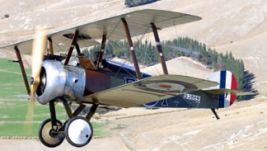
The Sopwith Camel was one of the most significant aircraft to emerge from the First World War by claiming the most victories than any other Allied aircraft during its time. New Zealand fighter ace Clive Collett was the first Allied pilot to ever record a victory in a Camel during the War. The Camel that is to be displayed at the Airshow is a full scale replica which is on loan from the Omaka Fighter Collection in Blenheim.
The only German aircraft to be displayed at the Airshow will be the Fokker Tri-plane. The full scale replica took three years to build and first flew in 1985. The Tri-plane is known for its excellent manoeuvrability in aerial combat, and reaches a top speed of 165 kmph. It is owned by the Omaka Fighter Collection after being purchased from original owners and builders Stuart Tantrum and John Lanham.
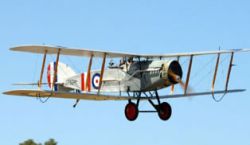
The Bristol Fighter comes to Warbirds Over Wanaka also from the Omaka Fighter Collection. The 'Brisfit' or 'Biff' as it was affectionately known as during the War, was flown by the Royal Flying Corps (which later became the Royal Air Force) from 1917-1932. It was used as a fighter aircraft and light bomber but was most famous for its rear-mounted machine guns. As it was a two-seater aircraft it enabled the pilot to have a gunner on board who fired at the enemy from the rear of the aircraft. Notable Kiwi aviator Sir Keith Park flew Bristol's with the Royal Flying Corps, and there were seven Bristol's in service in New Zealand. They were used for various duties including training, aerial surveying, meteorological information, and army communication. The aircraft that is making its debut appearance at the Airshow is a replica which was built in Memphis, Tennessee, first flew in 1993, and has been in New Zealand since 2001.
 The Avro 504K is an aircraft that is steeped in New Zealand history. Its first flight was in 1913 and was originally used as a bomber but then was relegated to training. Twenty Avros were gifted to New Zealand in 1920, and on August 25th of the same year Kiwi fighter ace Euan Dickson completed the first ever aerial crossing of Cook Strait in one. The Avro on display at Warbirds Over Wanaka is a replica which was built several years ago in the United Kingdom and housed at Duxford. In 2001 the Avro was bought by the Old Stick and Rudder Company who shipped it to New Zealand.
"Each aircraft has a tie with New Zealand - even the German Fokker which was originally owned by one of our Alpine Fighter Collection pilots, John Lanham. A lot of people forget about the significance of World War One aircraft in shaping our aviation history, which is why we are delighted to confirm the four aircraft which will make their Warbirds Over Wanaka debut. Next years show will highlight the development of aircraft during the last century, and there will be something for everyone to enjoy," Johnston said. "People will be able to see the rapid evolution of the aeroplane, from the 1913 Avro 504K through to the Cessna Citation Jet, and everything in between."
|
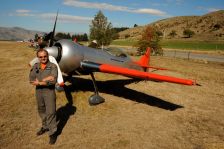
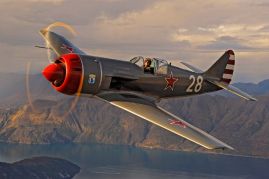
Lavochkin LA-9 to appear at Warbirds Over Wanaka International Airshow 2004. Gavin Johnston, General Manager of the Warbirds Over Wanaka Airshow, announced today that the only airworthy Lavochkin LA-9 in the world is to be showcased at next years airshow. "We are so thrilled to finally be able to present the LA-9 at our show. It was supposed to be ready in time for the 2002 Airshow but due to complications with the rebuild of the engine, was unable to make it."
|
 |
Warbirds Over Wanaka General Manager Gavin Johnston announced today that the only remaining airworthy RNZAF Chance Vought Corsair is to return to New Zealand for 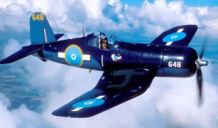 Warbirds Over Wanaka 2004. "After an absence of over thirty years we are very pleased to advise that a real Kiwi Corsair will once again be seen in New Zealand skies".
The RNZAF operated over 400 examples in the Pacific Theatre during WWII but by the late 1950's most had been sold for scrap. One remained, however, outside its owners garage at Rukuhia near Hamilton until the early 1960's. Restored to a taxiable condition, the aeroplane appeared at the opening of Hamilton Airport in 1966 before languishing outside again. She was shifted to Auckland's Museum of Transport and Technology in 1968.
Sold to the USA in 1971, Corsair NZ5648 was fully restored to flying condition over quite a lengthy period and took to the skies again in 1982. In 1991, the Corsair was purchased by the Duxford (UK) based Old Flying Machine Company where she was repainted back into her original RNZAF colour scheme.
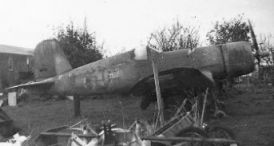 "It will be wonderful to see a Corsair back in New Zealand skies again" Johnston said. "The fact that it is owned and flown by a New Zealander makes it very special", he noted. The aircraft will be flown by Keith Skilling, who regularly displays the Corsair at airshows in England and Europe. The aircraft is owned by Ray Hanna of the Old Flying Machine Company who has regularly displayed aircraft at Warbirds Over Wanaka. The aircraft will arrive in NZ by sea prior to the event and displayed exclusively at Warbirds Over Wanaka 2004.
Gavin Johnston also said "the Warbirds Over Wanaka committee are very excited about the return of this aeroplane and we are sure it will appeal to the record crowds expected to attend.
Apollo Astronaut to be Special Guest at Warbirds Over Wanaka International Airshow 2004.
"Buzz" Aldrin, the second man to walk on the moon, will attend Warbirds Over Wanaka International Airshow 2004 it was announced today by airshow General Manager Gavin Johnston. "We are very excited that Buzz will be a special guest at our airshow over Easter 2004" said Gavin. "Buzz is looking forward to visiting New Zealand and spending a weekend in Wanaka enjoying the special magic of our airshow". "During his time here Aldrin will be interviewed over the public address system and he will also spend some time mingling with visitors in the Gold Pass Area".
"With the airshow now only a year away we look forward to announcing further details of aircraft attendance and other exciting events on a regular basis" Johnston said.
Warbirds Over Wanaka commences on Friday 9th April 2004 with a trade display open to the public and aircraft practising overhead. Saturday 10th and Sunday 11th are the two airshow days with continuous flying from 10-00am to 4-00pm. Over 50 aircraft are expected to attend.
Buzz Aldrin Background
Buzz Aldrin was born in Montclair, New Jersey on January 20, 1930. His mother, Marion Moon, was the daughter of an Army Chaplain. His father, Edwin Eugene Aldrin, was an aviation pioneer, a student of rocket developer Robert Goddard, and an aide to the immortal General Billy Mitchell. Buzz was educated at West Point, graduating with honors in 1951, third in his class. After receiving his wings, he flew Sabre Jets in 66 combat missions in the Korean Conflict, shooting down two MIG-15's. Returning to his education, he earned a Doctorate in Astronautics from the Massachusetts Institute of Technology in Manned Space Rendezvous. The techniques he devised were used on all NASA missions, including the first space docking with the Russian Cosmonauts.
In October 1963, Buzz was selected by NASA as one of the early astronauts. In November 1966, he established a new record for Extra-Vehicular Activity in space on the Gemini XII orbital flight mission. Buzz has logged 4500 hours of flying time, 290 of which were in space, including 8 hours of EVA. As Backup Command Module Pilot for Apollo VIII, man's first flight around the moon, he significantly improved operational techniques for astronautical navigation star display. Then, on July 20, 1969, Buzz and Neil Armstrong made their historic Apollo XI moon walk, thus becoming the first two humans to set foot on another world. This unprecedented heroic endeavor was witnessed by the largest worldwide television audience in history.
Upon returning from the moon, Buzz embarked on an international goodwill tour. He was presented the Presidential Medal of Freedom, the highest honor amongst over 50 other distinguished awards and medals from the United States and numerous other countries.
Since retiring from NASA, the Air Force, and his position as Commander of the Test Pilot School at Edwards Air Force Base, Dr. Aldrin has remained at the forefront of efforts to ensure a continued leading role for America in manned space exploration. To advance his lifelong commitment to venturing outward in space, he has created a master plan of evolving missions for sustained exploration utilizing his concept, "The Cycler", a spacecraft system which makes perpetual orbits between Earth and Mars. In 1993 Dr. Aldrin received a U.S. patent for a permanent space station he designed. More recently he founded his rocket design company, Starcraft Boosters, Inc., and the ShareSpace Foundation, a nonprofit devoted to opening the doors to space tourism for all people.
Dr. Aldrin has continued to share his vision for the future of space travel by authoring two space novels that dramatically portray man's discovery of the ultimate frontier: The Return (Forge Books, 2000) and Encounter with Tiber (Warner Books, 1996). He has also authored an autobiography, Return to Earth and a historical documentary, Men from Earth, describing his trip to the moon and his unique perspective on America's space program.
On Valentine's Day 1988, Buzz married Lois Driggs Cannon of Phoenix, Arizona. She is a Stanford graduate, an active community leader in Southern California, and personal manager of all of Buzz's endeavors. Their combined family is comprised of six grown children and one grandson. Their leisure time is spent exploring the deep sea world of scuba diving and skiing the mountain tops of Sun Valley, Idaho.
Now Buzz, as Starcraft Enterprises - the name of his private space endeavours - is lecturing and traveling throughout the world to pursue and discuss his and others' latest concepts and ideas for exploring the universe. He is a leading voice in charting the course of future space efforts from Planet Earth.
Vintage machinery has been on display at the Warbirds Over Wanaka airshow since 1988 when at the "Warbirds On Parade" that year, Mr George Wallis brother of Sir Tim Wallis displayed his extensive collection of McCormick Deering tractors and machinery at the airshow. A collection of working stationary engines was also mounted by members of the Clyde museum.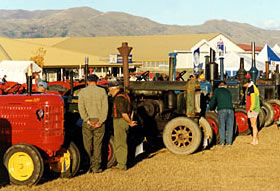
In 1990, the organisers of the airshow decided to invite vintage enthusiasts everywhere to bring their restored farm machinery to expand the show and widen the scope and nature of the display.
In early years New Zealand did not have any tractor manufactures, so all tractors had to be imported by stock firms for their clients. The wide variety of makes and models on display at the 2004 airshow will be testament to this. The United States and England were the main countries of origin but New Zealand also imported tractors from Australia, Germany, France, Italy and the communist block countries among others.
As well as the static and working displays, activities for vintage machinery during the Warbirds Over Wanaka 2004 airshow will include a Lanz Bulldog starting competition. The Bulldog is a very strong tractor with a hot-bulb ignition and is started by heating the bulb with a blow lamp, removing the steering wheel and using it to turn the crankshaft. The skill is in removing the steering wheel as the engine fires. This can be quite spectacular to watch. A tractor and sledge pull competition will also be in operation using a weight transfer device which tests the pulling power of the tractor.
There will be thrashing and bailing demonstrations using a stationary baler.
The tractors on display will be mainly from the 1930 to 1950 era and will be an indication of the wide variety of farm machinery and implements employed by New Zealand farmers during and after the Second World War.
The 2004 exhibition will be a grand affair and something not to be missed. Take the opportunity to visit this extensive display from Good Friday onwards. Tractors and Farm Machinery have played a considerable part in the history and development of New Zealand and the display at the 2004 airshow will be a very good example of the types which helped shape New Zealand's past
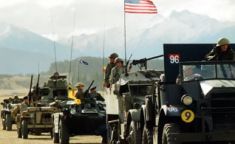 The Warhorses at Wanaka group are once again responding to the call to put on a professional display for the 2004 airshow.
Restorers, collectors and re-enactors will return to the Wanaka airfield to display items connected to New Zealand's military history.
The show will feature Warhorse displays that reach new heights of interest and authenticity. Restored vehicles never seen before will be on display along with a presentation of re-enactments and scenic backdrops depicting the various theatres of war over the last century. This display will bring back nostalgic memories for those veterans of the war years. The displays will not only provide many photo opportunities, but also the chance for the younger generations to appreciate the rigors and simple technology of the past.
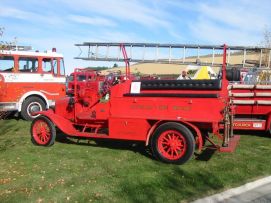 Many of the earliest initiatives for fire fighting back in the 1800's and the last century came from insurance companies. Faced with the prospect of massive losses from uncontrolled fires, it was insurance companies who organised and funded equipment for "brigades" both here in New Zealand and in many places overseas.
It is entirely appropriate therefore we welcome an insurance company as a sponsor for "AMI Insurance Classic Fire Engines" at Warbirds Over Wanaka International Airshow 2004.
AMI have had a long association with classic fire appliances, having owned their own much-travelled bright yellow Dennis F8 "AMI" for a number of years. "AMI" has been seen in many parts of New Zealand on the road with the fund-raising Variety Bash and in support of many charitable and promotional causes. Elderly fire engines typically have recorded very low mileages, but "AMI" would be the obvious exception being well-known to thousands as it travelled the country's roads.
The 2004 display will draw on appliances from the collections of brigades and individual "fire buffs" from throughout Otago and Canterbury. Warbirds Over Wanaka was the first event to incorporate classic fire engines into the historic aviation and vintage machinery theme and this successful and popular mix continues for the fifth consecutive time at Warbirds Over Wanaka International Airshow 2004.
If you like something different you’ll like the Warbirds Catalina. It's like no other aeroplane you’ll ever see - and it can land on water!
It is owned and operated by the Catalina Club on New Zealand Inc and was purchased in 1994 where it had been operating tourist safaris around Africa from its base in Zimbabwe. This particular aircraft is 58 years old, being built in Canada in 1944. It is a true warbird in that it saw wartime service during WW2 with the Royal Canadian Air Force before being retired and then taken over by various commercial operators in Canada and then Africa.
Catalinas also saw service with the Royal New Zealand Air Force which flew them in the Pacific Theatre, as did the Royal Australian Air Force.
The Catalina’s design goes back to the mid-1930s but, although the wings, wing-tip floats and hull have not been altered much, the two distinctive blister windows have been added to the aft cabin and it has received more powerful engines.
During WW2 Catalina’s were used to rescue pilots and other aircrew who had been forced down onto the sea. Such rescue operations involving landing in the open sea, were referred to as Dumbo missions, after the Walt Disney character Dumbo the Flying Elephant. Perhaps the aircraft should more rightly have been called Mother Duck?
Because it has such a low flying speed, the Catalina was ideal during the war years for ship convoy patrol out over the oceans and for general maritime duties. It could also stay aloft for 14-15 hr sorties looking for enemy submarines or signs of periscopes and carried depth charges to attack the submarines. Even today, the slow speed and long endurance of the Catalina are hard to match.
The Catalina flies down to Wanaka from its home base in Auckland whenever it can and supports the spirit of the Warbirds Over Wanaka movement that was started by Sir Tim Wallis. It is a very historic aircraft and is very much a part of our aviation heritage and that of Australia.
Boys Behind The Bangs
One of the highlights for visitors to Warbirds over Wanaka is the mock attack held at the end of each days show. As the fighters scramble to protect the crowd, a host of fireballs, bombs, rockets and machineguns reign supreme on the far side of the airfield.
This highly choreographed scenario is the responsibility of Peter Gallagher, Kevin ‘Bomber’ Harris and a small team comprising Debbie Gallagher, Kevin and Sandra Hill and volunteers. Gleefully residing over controlled mayhem, the pyrotechnic team spend many hours testing, assembling and preparing for their twenty minutes of fame.
All of the pyrotechnic displays are required to meet strict guidelines and safety is paramount. Preparations begin over six months before the show when Kevin can be seen searching books and publications looking for his next creation to explode. In 2000 a V-2 rocket majestically rose before the crowd only to be consumed by flames and smoke. Made from 44 gallon drums scrounged around the airfield it was crafted over a number of hours to be promptly destroyed in minutes.
As show time gets closer and the flying programme is finalised the team look at each scenario and prepare the pyrotechnics that will be included. Perfectionists, a number of trial explosions are undertaken to ensure the perfect fireball (and resultant smoke-ring). Because it is a two day airshow however, everything prepared for Saturday has to be duplicated for Sunday. This means late evenings and early mornings!
As well as the fireballs the team also create gunruns (and yes, we do remember the shots that went the wrong way!) and the occasional building that needs to be destroyed.
As the show days approach a close liaison with pilots is obviously required. Special briefings are held between the team and pilots that will be flying aircraft over the pyrotechnics. To the uninitiated the aircraft can sometimes appear quite close to the bangs but in reality these carefully choreographed sequences mean that an aircraft is laterally separated from the explosion by a considerable safety margin.
The explosions are ignited by a number of electrical firing boxes connected to the charge. Over 3.5 kilometres of wiring (including some buried underground) stretches across the area. (Watch for Kevin on the Sunday morning hunting the airfield for wire).
The team are in constant communication with the Airshow Controller, Police and Fire Departments which allows them to react immediately to any changes in the programme. The entire far side of the airfield is under their control until the ‘allclear’ is given.
So, as you watch the show this year and marvel at the pyrotechnics we ask you to spare a thought for this small and dedicated team who have spent many hours of preparation to produce one of the best ‘explosive’ displays that can be seen anywhere.
